
The Future of Hiring: How Conversational AI is Eliminating the First-Screen Bottleneck
The recruitment world is facing a silent crisis: the first-screen bottleneck. With modern job boards enabling one-click applications, hiring teams are regularly inundated with hundreds, sometimes thousands, of resumes within hours of posting a role.
Faced with this tidal wave of data, recruiters have historically resorted to keyword screening—using Automated Tracking Systems (ATS) to filter out candidates whose resumes don't contain specific phrases. But this keyword-matching process is a poor proxy for human capability. It does not measure soft skills, communication clarity, problem-solving aptitude, or emotional intelligence.
As a result, high-potential candidates are routinely filtered out, while recruiters spend hours coordinating and conducting phone screens with candidates who look great on paper but lack the actual capabilities needed for the role.
The Failure of the Traditional Resume Filter
Up to 75% of resumes are rejected by software before a recruiter ever looks at them. While this solves the immediate administrative problem of having too many applicants to review, it introduces significant long-term costs:
- Loss of Hidden Talent: Career switchers, self-taught programmers, and candidates with non-traditional educational backgrounds are rejected because they lack the "right" keywords.
- Pedigree Bias: Resume filters favor candidates with prestigious university degrees or famous companies on their CV, reinforcing systemic biases.
- Recruiter Burnout: Coordinating schedules, sending follow-ups, and conducting repetitive, 15-minute phone screens takes up to 60% of a recruiter's work week.
Enter the AI-First Screening Agent
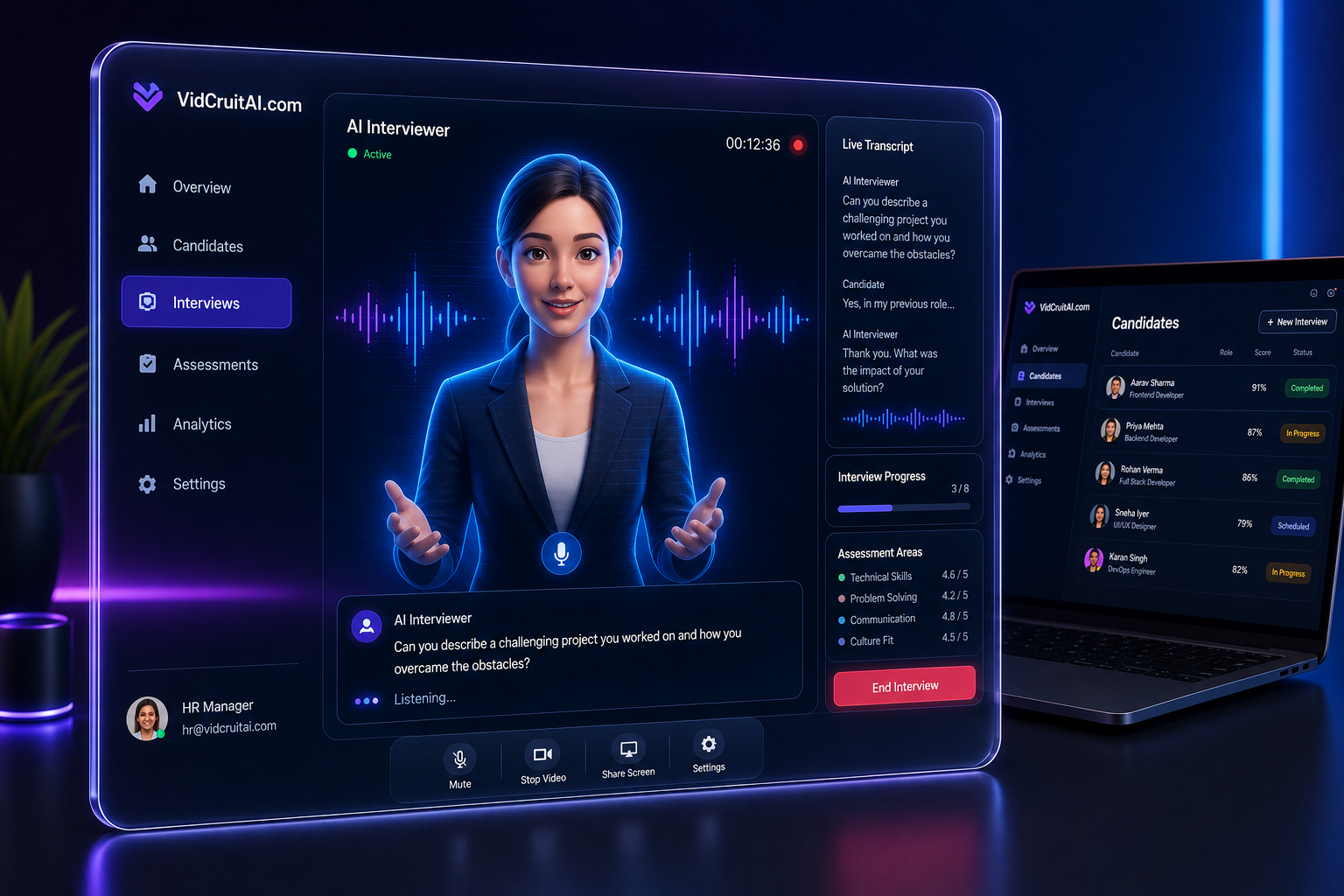
Conversational AI screening changes the equation. Instead of filtering resumes, VidCruitAI enables organizations to offer an instant, 10-minute automated video and voice screen to every single applicant immediately upon submission.
1. Immediate, Accessible Screens Candidates take their first-stage assessment at their own convenience. There is no scheduling back-and-forth, no time zone conflicts, and no delays. The moment they click "Apply," they can start their screen.
2. Adaptive Conversational Questions Unlike rigid, one-way video recording tools where candidates talk to a blank screen, a conversational AI agent listens to answers and adapts dynamically in real-time. If a candidate mentions managing a complex team conflict, the AI asks follow-up questions to understand the resolution steps, just like a seasoned recruiter would.
3. Objective Competency Evaluation Every candidate is evaluated on identical metrics of communication clarity, situational logic, and core job competencies. Because the AI evaluates transcripts and semantic structure rather than vocal accents or gender identifiers, the results are objectively fair and audit-compliant.
Sifting Competencies from Noise
By leveraging natural language processing and semantic alignment graphs, the AI system delivers a unified dashboard of candidate transcripts, soft skill breakdowns, and performance analytics.
"We are transitioning from a system that screens people OUT based on a piece of paper, to a system that invites people IN based on their actual verbal expression and capability."
This shift enables recruiting teams to make data-driven decisions. Instead of spending weeks sorting resumes, recruiters can immediately review the top 10% of candidates who have already demonstrated their skills during the conversational screen.
The Human-in-the-Loop Paradigm
Automating the first screen does not mean removing humans from the hiring process. Rather, it elevates the human role. By outsourcing administrative scheduling and repetitive screening tasks to AI, recruiters can focus on what they do best: deep evaluation, cultural fit analysis, and crafting a premium candidate experience.
The future of hiring is immediate, fair, and conversational.